

HIGH QUALITY MADE IN CHINA
Fujian High-Made Intelligent Equipment Manufacturing Co., Ltd. specializes in the research, development, manufacturing, and sales of automated packaging production line solutions, including automatic quantitative packaging equipment, automatic vacuum shaping packaging machines, secondary packaging, robot palletizing and conveying systems. Our products are widely used in automated packaging production lines for various granular or powdered materials such as rice, feed, nuts, miscellaneous grains, melon seeds, corn, seeds, etc.
Our Advantages
Complete Production Management System
Our company strictly implements ISO production management system and 6S management model to form a production management model with lean production, standardized management and specialized services.
Extensive Business
Now our business has expanded to 32 provincial administrative regions and exported to Southeast Asia, Middle East and other countries. As an important strategic partner with famous domestic industries such as Cofco, Yihai Kerry, Beidahuang Group etc.
Strong R&D and Innovation Capabilities
Independent R&D center with over 20 senior R&D personnel. Our company got a professional talent group who works for a long time on the vacuum, shaping and automatic packing system.
One-stop Solution
Our service runs throughout the whole production process from the pre-sales, product design, production and after-sales. Support to customers to ensure a smooth transaction.


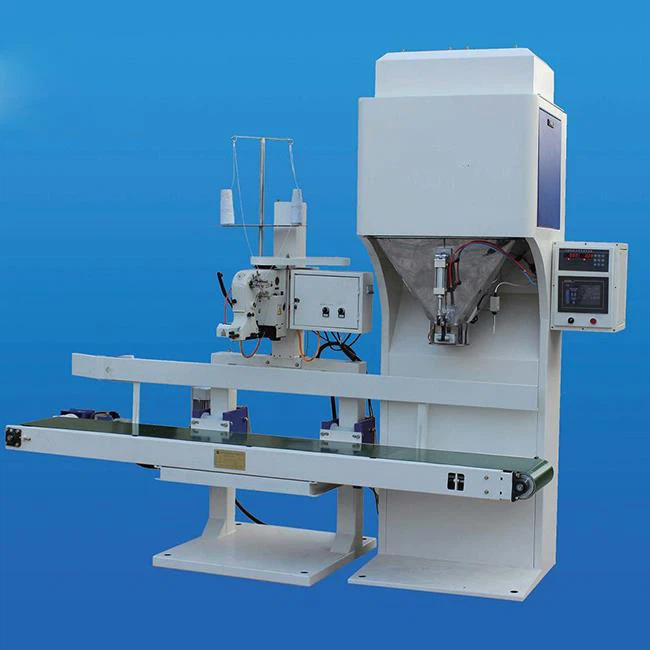
After entering the automatic operation state, the weighing control system opens the feeding door to start feeding. The feeding device is a two-stage feeding mode of fast and slow; when the weight of the material reaches the set value of fast feeding, the fast feeding is stopped and kept Slow feeding; when the weight of the material reaches the set value, close the feeding door to complete the dynamic weighing process; at this time, the system detects whether the bag clamping device is in a predetermined state, and when the bag is clamped, the system sends a control signal to open the weighing The discharge door of the measuring hopper, the material enters the packaging bag, and the discharge door of the weighing hopper is automatically closed after the material is discharged: After the material is discharged, the bag clamping device is released, and the packaging bag automatically falls; the packaging bag is sewn and transported after it is dropped Go to the next station. In this way, it runs reciprocally and automatically.
In the weighing list, the trolley, the package delivery device, the pneumatic system, the public system, and the complete package control instrument are composed. Among them, the key part M that affects the packing speed and accuracy is the weighing unit, which includes
Storage bin. Gate. Cut the material for housing, the scale body clamps the bag for storage, the bracket. The electrical control is installed, etc. Storage silo; it is a buffer storage silo that uses dry materials to store and provide a uniform material flow; gate] dry storage
The bottom of the silo is used to seal the material in the storage silo when the equipment is overhauled or malfunctions; the intercepting device is composed of a intercepting hopper, a intercepting door, pneumatic components, an air supply valve, etc., which provide fast speed during the weighing process. , Slow two-stage feeding, the material flow of fast and slow feeding can be adjusted separately, so as to ensure that the quantitative packaging scale meets the accuracy requirements and speed requirements of the measurement; the function of the supplementary valve is to balance the air in the system during weighing Pressure difference; The scale body is mainly composed of a weighing hopper, a load-bearing bracket and a load cell, which completes the transformation from weight to signal and transmits it to the control unit; the bag clamping device is mainly composed of a bag clamping mechanism, pneumatic components, etc., which functions to clamp the packaging Bag, so that all the weighed materials fall into the packaging bag; The electrical control device is composed of weighing display electrical components and control cabinets, which are used to control the work of the system, so that the entire system works in an orderly manner according to a preset program.
chemical industry, food, feed, plastics, building materials, seeds, fertilizers, granular compound fertilizers, soups, washing powder, sugar.
How is A Bagging Scale Optimum For Bagging Systems?
In terms of bagging systems, a bagging scale is a piece of equipment that weighs and dispenses a specific amount of dry bulk material (powder, pellet, granule, etc.) into an open mouth bag. Depending on the application and product characteristics, the bagging scale will utilize one of four main material metering methods, use the bulk and dribble feeding technique and operate based on net-weigh or gross-weigh functionality.
Material Metering Methods for Open Mouth Bagging Scales:
The goal in determining which metering device to use in your bagging system is based on what will transfer the material most consistently. The more consistent the material flow, the more accessible it is for the controller to decide which step to take to achieve accuracy and speed. Knowing the flow characteristics of various products is invaluable when designing a project.
Gravity:
Using cutoff gates, gravity bagging scales use the product's flow characteristics to fill the open mouth bag. These gates close when the bag has reached the desired weight. Free-flowing granular products such as grains, fertilizer, salt and small pellets are packaged using the gravity method.
Vibratory:
Vibratory feeding scales utilize side-to-side movement of the vibratory tray to transfer the product into the bag. These scales use varying vibratory speeds to move difficult materials or provide precise, accurate measurements of granular material. This bagging system is best suited for materials that do not flow easily or have irregular shapes, such as ground coffee, light-density grass seed or granola, which usually incorporate vibration with open mouth bag fillers.
Belt:
Belt-feeding scales are used for packaging material that sticks to itself during filling. The belt feeder uses adjustable product height and speed settings to accurately deliver the product into the open mouth bag. Sweet molasses-based cattle feed, mulch and topsoil are bagged on belt feeder units.
Screw:
Screw-feeding scales transfer dry materials volumetrically, either horizontally or at an incline, through the scale into a bag. A variable speed drive on the screw feeder and shutting gates on the scale allow for bulk and dribble feeding cycles to ensure accuracy. Various powders and granules, from flour ingredients to asphalt, can be metered with a screw in this bagging system.
Bulk and Dribble Feeding to Increase Accuracy:
Most open mouth bagging scales utilize the bulk and dribble feeding method. Bulk and dribble feeding follows the same principle as gravimetric feeders: filling fast to nearly the target amount and then filling slowly to achieve accuracy of the last 10-20% of the target amount. Each bagging scale utilizes two gates. The first portion of the bulk operation is filling with the gates completely open. Then, the dribble portion is achieved by partially closing the gate opening to hit the desired target fill. When using a screw-to-meter material, like the APO Dual, it uses two different-sized augers – one large and one small – to complete the same method. The large auger fills the bulk of the target fill, and the smaller auger does the target amount's dribble or "trim" filling. Now, a lot of programming goes into the controls to make all of this happen smoothly and efficiently. This is where the T4000 controllers come into play. Learn more about the T4000 here.
Net-Weigh vs. Gross-Weigh Feeding:
The net weight of a dry material during the bagging process is captured by filling a "bucket" inside the scale until the desired weight is met. The scale controls are only concerned with the weight of the material in the "bucket." Net-weigh feeding allows for faster bagging rates, typically an increase of 1-2 bags per minute since you are doing two actions simultaneously. The next weight (volume of product being weighed) is dispensed into the bucket while a new bag is placed or held in position.
Capturing the gross weight of a dry material during the bagging process is done by zeroing out the weight of the equipment and bag placed on the discharge spout in programming. Gross-weigh feeding is typically slower than net-weigh feeding since you have to wait until the bag is filled and released from the spout before placing another bag and filling.
In Summary:
Within a bagging system, there are four ways dry materials are transferred when using open mouth bagging scales: gravity, vibratory, belt and screw. The bulk and dribble feeding method and programmable controllers increase accuracy. Net-weigh and gross-weigh feeding are the two scale-weighing functions.
What you Need to Know About Thermoforming Packaging Machines


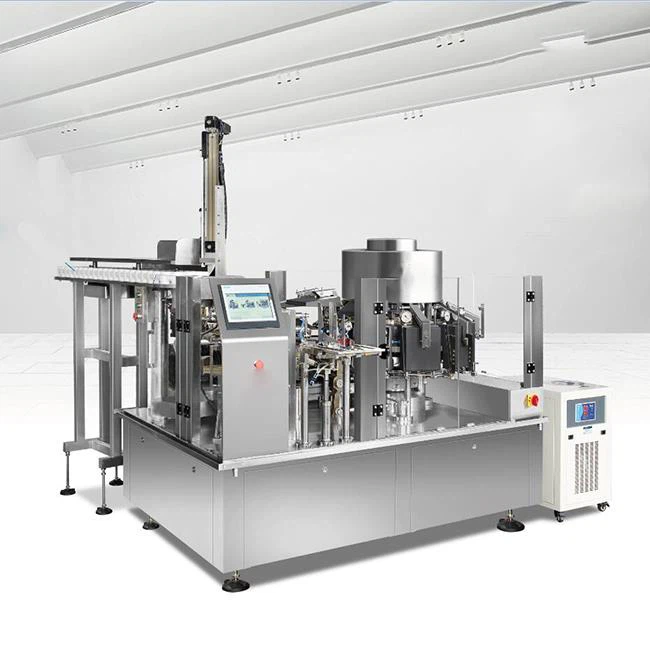
Thermoforming packaging machines use heat and pressure to form plastic sheets into desired shapes for packaging products.
The process begins with a roll of plastic sheeting being fed into the machine. The sheet is then heated until it is soft and pliable.
Once it is heated, the sheet is formed into the desired shape using molds or dies. Finally, the molded sheet is cooled and trimmed to create the finished product.
What is Thermoforming Packaging Machines
Thermoforming packaging machines are used to package food, beverages, and other products.
The machines use heat to form the packaging material around the product.
Thermoforming packaging machines are available in various sizes and can be customized to meet the needs of your business.
Other models of Thermoforming Packaging Machines
Thermoforming packaging machines are used in a wide variety of industries for packaging products.
They can be used to package food, beverages, pharmaceuticals, cosmetics, and many other types of products.
There are many different models of thermoforming packaging machines, each with its own specific features and benefits.
Some of the most popular models include the rotary type, the reciprocating type, and the shuttle type.
About thermoforming machine for food packaging
Thermoforming is a manufacturing process where a plastic sheet is heated to a pliable forming temperature, formed to a specific shape in a mold, and trimmed to create a usable product.
The sheet, or "web", of material used in the thermoforming process can be purchased pre-cut to size or cut to size by the thermoformer.
To form the web into the desired shape, it is placed into a female mold (or negative of the desired shape).
Then, depending on the type of forming method used, air pressure is applied from below the web (positive pressure forming), above the web (negative pressure or vacuum forming), or both above and below the web at once (twin-sheet forming).
After sufficient time has passed for heating and/or application of vacuum or pressure, as well as cooling for some materials, the part is removed from the mold.
About thermoforming blister packaging machine
A thermoforming blister packaging machine is a type of machine used to form plastic into desired shapes.
The process of thermoforming blister packaging generally involves heating a sheet of plastic until it is soft enough to be shaped, and then using a mold to form the plastic into the desired shape.
After the plastic has cooled and hardened, it can then be used for packaging purposes.
Thermoforming blister packaging machines can be used to create a variety of different packaging designs, including those that are intended for use with food products, medical devices, and other types of products.
Understanding the Thermoforming Blister Packaging Process
Blister packaging machines typically use a three-step process to manufacture packs
◆ Forming: A forming mold is used in either the thermoforming or cold forming process to create a tray with cavities or pockets that match specific product requirements.
◆ Sealing: During the sealing process, your product is placed inside the cavities. Then, the trays are sealed with precut pieces of your choice of lidding material using knurled or flat heat-sealing plates.
◆ Perforating and Cutting: Finally, the sealed trays are cut and perforated using a precision die cutter.
Different Forming Processes for Blister Packaging
The forming process for blister packs creates the packaging's cavities or pockets where the tablets or capsules are placed. After the packs are designed, they're ready to be formed using one of two methods—thermoforming or cold forming.
The Thermoforming Blister Packaging Process.
Thanks to its simplicity and high volume production, thermoforming is the most common method used for blister packaging. Clear PVC sheets are heated with upper and lower heating plates before being inserted into the blister packaging machine. While the sheet is soft and pliable, it can shape to the selected mold with application pressure, sometimes with help from a mechanical stamp (if the design is complex).
The Difference Between Thermoforming and Cold Forming
On top of thermoforming blister packaging using heat while cold forming doesn't, the former uses clear PVC materia and the latter uses aluminum-based film. Cold forming material and equipment costs tend to be higher since the method uses custom blister tooling. Thermoforming isn't not suitable for light-sensitive drugs due to the clear PVC material. However, cold forming is commonly used for packaging products sensitive to moisture and light.
Thermoforming Blister Packaging Methods
There are two common thermoforming methods used to manufacture blister packs:
◆ Vacuum Forming
In this process, after a plastic sheet is heated until malleable, it's draped over the mold and sucked into shape by a vacuum. When it has cooled and hardened, the finished blister pack is ejected. In its more advanced forms, vacuum forming utilizes sophisticated pneumatic, hydraulic, and heat controls to enable faster production speeds and more intricate details in the final pack. This allows for the fabrication of more complicated designs in a shorter amount of time than with other forming methods. Vacuum forming also produces more durable, cost-effective packaging compared to other techniques.
◆ Pressure Forming
When the desired shape is too difficult to form by air alone, pressure forming enables a plug-assist feature to push the films into the die for a more uniform wall thickness. Refrigerated plates then press the film into its new shape. After that, a die cutter trims the film to size. Efficient and cost effective, pressure forming requires minimal equipment and provides an effective way to create intricate shapes without compromising on quality or precision. Additionally, it can be used with a variety of materials such as PET, PVC, PP, and even paperboard.
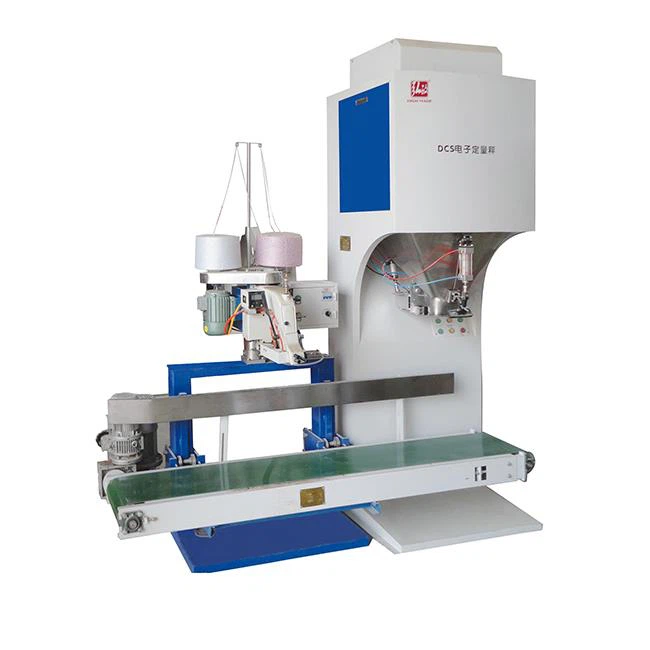
First, the whole weighing process can be divided into three stages: fast feeding, faster feeding, and slow feeding, each stage is perfect. At the same time, it can be equipped with automatic sewing equipment and conveying equipment to form a highly automated production line.
Second, after the packaging scale enters the automatic operation state, the weighing control system opens the feeding door to start feeding. The feeding device is a fast and slow two-stage feeding mode; when the weight of the material reaches the set value of the fast feeding, the fast feeding is stopped. Keep feeding slowly; when the weight of the material reaches the final set value, close the feeding door to complete the dynamic weighing process; at this time, the system detects whether the bag clamping device is in a predetermined state, and when the bag is clamped, the system sends a control signal Open the weighing hopper discharge door, the material enters the packaging bag, the discharge door of the weighing hopper is automatically closed after the material is discharged; the bag clamping device is released after the material is discharged, the packaging bag automatically falls; the packaging bag is sewn after it is dropped And transport to the next station. In this way, it runs reciprocally and automatically.
Packaging machinery has a wide range of uses in the market: Food, chemical, pharmaceutical, and light industries are all used (and some agriculture production).
Easy to use (automatically complete bag making, metering, blanking, sealing, slitting, counting, batch number printing, and other functions.)
High efficiency: The output of packaging machines in the Chinese market can be close to 120-240 pack minutes to replace the handmade products in the 1980s, and the output is much more than several times that of the time.
Clean, hygienic, and energy-saving. Use the packaging machine to be clean and hygienic, no manual work is required. It is possible to use clean, hygienic, material-saving, bag-saving, cost-saving, and environmentally friendly functions.
Side-opening protective baffle with good visibility, and safe operation.
The Benefits to Food Packaging of Using a Vacuum Sealer Machine
The vacuum sealer machine is a game-changer in the food industry. It addresses the challenge of maintaining the integrity of goods in a landscape where shelf life and sustainability are crucial.
With the increasing need for fresh and sustainable products, this machine provides a solution that bridges the gap. Its role is to offer a transformative approach to food packaging.
This article delves into the numerous benefits this machine brings to the food industry. From extending shelf life to reducing food waste and enhancing product quality, let's explore its advantages.
Why Use a Vacuum Sealing Machine?
When it comes to food packaging, maintaining freshness is non-negotiable. However, vacuum sealers may be the most appropriate solution to this. They offer benefits that can greatly impact your business and customers.Here are some of them:
Extended Shelf Life
One of the most significant advantages of utilizing this machine is extending the shelf life of packaged products.
By removing air from the packaging, the machine creates a vacuum-sealed environment that hinders the growth of spoilage microorganisms. This preservation technique ensures your food products remain fresh for more extended periods.
Whether dealing with fresh produce or meats, a food sealer machine guarantees that your products reach customers with maximum freshness.
Reduced Food Waste
Food waste is a global issue known to hurt businesses and the environment. A vacuum sealer contributes significantly to the fight against food waste by preserving food products longer.
Reducing the chances of products spoiling before sale or consumption results in financial savings and less strain on natural resources. Integrating this technology into your packaging plan shows a firm commitment to sustainability and ethical business practices.
Enhanced Flavor and Quality
Using a machine that seals food doesn't only extend the shelf life of goods. It also preserves their quality and flavor.
By removing exposure to oxygen, vacuum-sealed packaging prevents oxidation and freezer burn, which can negatively affect taste and texture. This technology ensures that your customers can enjoy the same great taste and quality they expect, from the first bite to the last.
This commitment to flavor and quality enhances customer satisfaction and can set your brand apart.
Improved Hygiene and Safety
Hygiene and safety are paramount in the food industry. Thanks to these vacuum sealing machines, you create an airtight seal that prevents contaminants from entering the packaging. This additional layer of protection guarantees that your food products remain safe for consumption.
With vacuum-sealed packaging, you can guarantee that your customers receive products that meet the highest safety standards. Also, you can build trust and loyalty while reducing the risk of recalls and related costs.
This focus on safety not only protects consumers but also safeguards your brand's reputation.
Optimized Storage Space
Efficient storage space utilization is another significant benefit of using a vacuum machine to seal food.
With the removal of air, your products occupy less space, allowing you to store more items in the same area. This practice can lead to reduced storage costs.
Efficient storage is not just about saving money but also about streamlining your operational processes. With an optimized storage area, you can manage your inventory and fulfill orders efficiently.
Additionally, reducing storage space requirements allows you to allocate resources to other critical aspects of your business, ultimately raising your ROI.
Improved Sustainability
Using a food vacuum sealer machine provides a benefit that resonates with sustainability efforts. By reducing food waste and the need for excess packaging materials, you actively contribute to a more sustainable food industry.
Less food waste means fewer resources used in the production of food that goes uneaten. Likewise, it translates into reduced strain on natural resources.
This eco-conscious approach aligns with the growing demand for sustainable packaging options and minimizes your environmental footprint. Vacuum sealing is not just about saving money. It's about making a positive impact on the planet.
Our Factory
With more than ten years of development, we have always focused on the product quality and technology innovation, and got a professional talent group who works for a long time on the vacuum, shaping and automatic packing system. Hide Made packing machines have grown much more higher stability and efficiency. Won the title of national high-tech enterprise, science & technology little giant leading enterprise, the third prize of innovation competition in Fujian province. Gold award of the International grain oil products and equipment technology exhibition.

FAQ
We're well-known as one of the leading filling packing scale manufacturers and suppliers in China for our quality products and low price. Please feel free to buy bulk filling packing scale for sale here from our factory.
Food packing machine