


Throughput Capacity and Operator Labor Allocation
Factory throughput requirements dictate whether a facility should deploy a semi-auto rice packing machine or transition to a fully auto rice packing machine. Semi-automatic systems rely on manual bag placement, capping output at 4 to 6 bags per minute (240–360 bags/hour) while requiring two operators per station for feeding and stitching. In contrast, an automated configuration achieves continuous operational rates of 12 to 18 bags per minute (720–1,080 bags/hour) with a single supervisor monitoring the line. Plant directors must evaluate volume demands: facilities processing under 20 tons daily typically favor semi-automatic flexibility, whereas high-volume mills exceeding 50 tons daily require automated line speeds to eliminate packaging bottlenecks.
Weighing Accuracy and Gravimetric Dosing Integration
Precision dosing is critical for minimizing product giveaway in bulk grain processing. Both system variants integrate with multi-head weighers or gross/net weight load cell assemblies, maintaining a tight static accuracy of $\pm 0.2\%$. However, dynamic weighing stability differs. A semi-auto rice packing machine depends on manual bag clamping, which can introduce minor operator-induced weight deviations during high-speed clamping sequences. Conversely, a fully auto rice packing machine utilizes servo-driven pneumatic grippers and automated bag stretching mechanisms, ensuring absolute dimensional stability during the discharge phase and keeping average weight giveaway below 5g per 50kg bag.

Capital Expenditure (CapEx) and Footprint Constraints
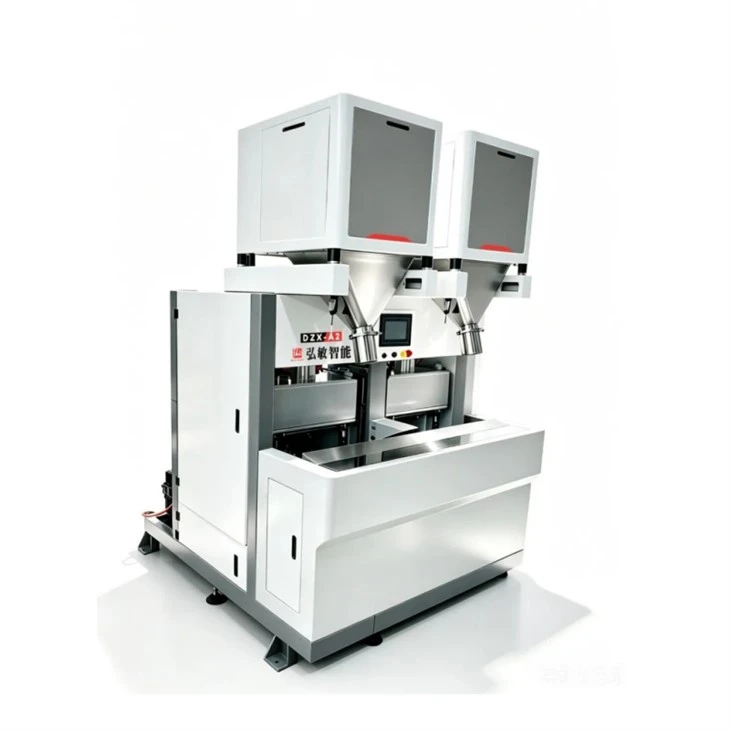
Financial planning and spatial parameters shape equipment selection. A semi-auto rice packing machine involves lower initial capital investment, a compact footprint under 4 square meters, and rapid installation times with minimal civil engineering modifications. Conversely, a fully auto rice packing machine demands a higher initial capital outlay and requires a dedicated linear footprint of 8 to 12 meters to accommodate automated bag magazines, robotic pick-and-place arms, and continuous heat-sealing or stitching conveyors. Plant engineers must verify that facility ceiling heights exceed 4.5 meters and that adequate three-phase power supplies (380V/480V) are available near the drop zone.
Return on Investment (ROI) and Payback Period Calculation
Justifying automation capital expenditure requires rigorous financial modeling based on labor reduction and material efficiency. While semi-automatic units keep upfront costs low, recurring labor expenses for manual bag handling drive up operational costs over a multi-shift schedule. Upgrading to a fully automatic system cuts direct packaging labor overhead by up to 70%. Factoring in reduced labor wages, minimized product spillage, and consistent OEE, a high-utilization facility typically achieves full cost recovery on a fully automated asset within 14 to 20 months, making it the economically superior choice for scale-focused grain processors.


How To Cooperate With Us?
Contact to explore more cost-effective packing solutions.
YouTube / TikTok / Facebook: highmadepackingmachine
Phone Number / WhatsApp / WeChat: +86 166 5996 0709
E-mail: sale2@hmpackingmachine.com