



15KG Rice flat Vacuum Packaging Machine
This dual-station automatic system combines weighing and filling, vacuum pumping and shaping, sealing, and finished-pack discharge. It is designed for 2.5-15 kg flat and semi-brick rice bags, subject to confirmation with the buyer's product and bag samples.

Dual-station rice vacuum packaging equipment shown on the current product page.
Built for production lines
Integrated Weighing, Vacuum Shaping and Sealing
The published configuration automates weighing and filling, vacuum pumping and shaping, sealing, and finished-product output. Its dual-station layout is intended to support stable production of approved rice packages while reducing manual handling between core process steps.
- Published pack-weight range from 2.5 kg to 15 kg
- Published approximate output of 650-700 bags per hour
- High-precision vibration control with a published per-pack error target within ±2 g
- One-button recipe switching is stated for approved production changeovers
- Bag compatibility includes flat, semi-brick, and selected premade pouch formats after verification
Production sequence
How the Flat Rice Packaging Process Fits Together
The machine combines the principal packaging steps in one system. Final interfaces still depend on the buyer's product feeding, coding, conveying, inspection, and case-packing requirements.
Bag Feeding
Approved premade bags are prepared for the selected production recipe and verified package format.
Product Filling
The integrated high-precision vibration-control process weighs and fills rice to the approved target.
Vacuum and Shaping
Air is removed and the filled bag is shaped to the approved flat or semi-brick presentation.
Sealing and Forming
The formed package is sealed according to the verified film and bag-mouth conditions.
Discharge
The completed package exits for inspection and connection to downstream conveying or case packing.
Format Changeover
The approved formula is selected for the next SKU and any required mechanical adjustments are completed.
Published data
Technical Specifications
| Parameter | Published specification | Procurement note |
|---|---|---|
| Pack-weight range | 2.5-15 kg | For approved two-side flat and semi-brick bag formats |
| Bag front width | Up to 380 mm | Confirm the exact filled-bag width using production-ready samples |
| Bag length | Up to 620 mm | Confirm together with seal position and finished package shape |
| Approximate capacity | 650-700 bags/hour | Actual output must be confirmed against the product and bag |
| Published weighing control | Per-pack error controlled within ±2 g | Verify using the buyer's rice, target weights, and operating conditions |
| Power supply | AC 380 V, three-phase, five-wire; 2.5 kW | Confirm destination-site voltage and frequency before order |
| Compressed air | 0.6 MPa; 3 m³/min | Confirm available air quality and connection conditions |
| Operating environment | 0-40°C; relative humidity below 90% | Site conditions should be reviewed during line planning |
| Equipment dimensions | 1769 × 1815 × 2252 mm (L × W × H) | Allow additional service, access, and connection space |
Performance note: Output and weighing accuracy are published values, not unconditional guarantees. Rice flowability, target weight, bag material, bag dimensions, product feed stability, settings, and downstream handling all affect achieved results.

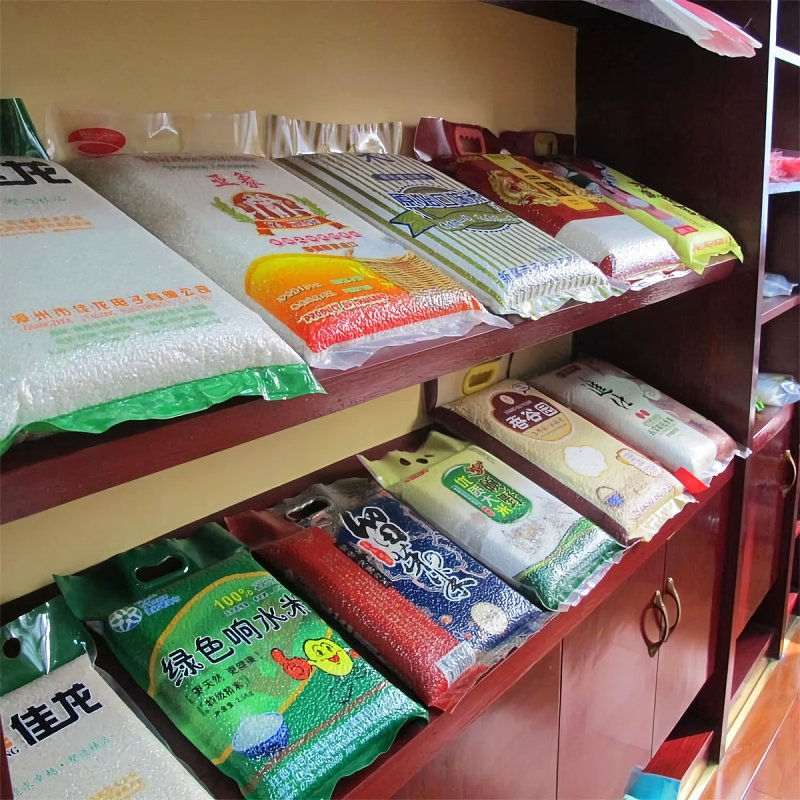
Published rice-pack application image from the current product page.
Bag qualification
Verify Every Planned Bag Format Before Final Selection
A nominal size match does not prove that a bag will run reliably. Final suitability should be verified using the buyer's rice and production-ready bag samples, including the film structure, seal layer, zipper or valve features, print registration, and finished package target.
- Published shapes include two-side flat bags and semi-brick bags
- The product description also lists 3-side-seal and stand-up pouch formats
- Doypack, zipper, and one-way-valve packages require feature-specific confirmation
- Bag strength, airtightness, opening behavior, and heat sealing must suit vacuum processing
- Provide samples for every planned weight and bag structure that will share the machine
Confirm Your Rice, Bag and Required Output
Send rice characteristics, pack weights, bag drawings and samples, expected bags per hour, site utilities, destination country, and upstream/downstream equipment details.
Typical use
Rice Packaging with Sample-Based Evaluation for Other Granules
The target application is flat and semi-brick rice packaging. The product page also shows granular-food applications, but the material, target weight, bag, and required output must be tested before another product is approved.

Rice and Grain Processors
For producers planning consistent flat or semi-brick presentation across several approved rice weights.

Contract Packers and Line Integrators
For projects that require the integrated system to connect with selected feeding, coding, conveying, inspection, or case-packing modules.
Selection checklist
Information Required for an Accurate Proposal
Product and Package
- Rice type, grain condition, flowability, and relevant product characteristics
- Each target net weight and expected bags per hour
- Bag style, width, length, film structure, seal layer, and thickness
- Flat or semi-brick shape, plus any zipper or valve features
- Actual printed, production-ready bag samples for testing
Line and Site
- Existing or planned product feeding equipment
- Required coding, inspection, and finished-pack handling
- Available voltage, frequency, compressed air, and floor space
- Conveyor height and upstream/downstream interface details
- Destination country, site layout, and commissioning expectations
For complete line planning, review the available weighing and filling equipment and supporting packaging-line equipment.
Engineering review
Testing, Integration and Delivery Planning
The proposal should close the gap between a catalog specification and an operating line. Sample trials, interface review, factory inspection, packing method, shipping route, and installation responsibilities should be confirmed for the selected configuration.

Sample and Machine Verification
Confirm bag opening, filling interface, vacuum result, seal quality, finished shape, abnormal-bag handling, and changeover steps against the approved samples.

Project Scope Confirmation
Agree the machine configuration, line boundaries, required documents, packaging for shipment, delivery basis, and site-service scope before order confirmation.
Related paths
Compare Machines and Plan the Complete Line
Buyer questions
Frequently Asked Questions
What rice pack weights does this configuration cover?
The published pack-weight range is 2.5-15 kg. Each planned weight and bag format still needs sample-based confirmation.
Which premade bag formats are supported?
The current page states two-side flat and semi-brick bags, and its description also lists 3-side-seal, stand-up, Doypack, zipper, and one-way-valve pouch formats. Final acceptance depends on actual bag testing.
What output can a buyer expect?
The published approximate output is 650-700 bags per hour. Actual output depends on rice characteristics, target weight, bag construction, settings, feeding stability, and downstream handling.
Why are rice and bag samples required?
Samples allow the supplier to check opening reliability, filling behavior, vacuum result, seal quality, finished shape, and changeover requirements before the configuration is approved.
What utilities does the published machine require?
Published requirements are AC 380 V, three-phase, five-wire power at 2.5 kW and compressed air at 0.6 MPa and 3 m³/min. Site voltage, frequency, and air conditions must be confirmed.
How is production changed between approved bag sizes?
The manufacturer states that approved production formulas can be switched using one-button recipe selection. Any mechanical adjustment and the validated settings for each SKU should be documented during commissioning.
What should be included in a quotation request?
Provide rice details, all pack weights, bag drawings and samples, required hourly output, site utilities, feeding and discharge interfaces, destination country, and expected service scope.
Hot Tags: 15kg sunflower seeds vacuum packaging machine, China 15kg sunflower seeds vacuum packaging machine manufacturers, suppliers, factory, brick vacuum packing advantage, brick vacuum packing manufacturer, brick vacuum sealer competition, vacuum packaging importer requirement of bricks, vacuum packing reliability for bricks, vacuum sealing regulation for bricks